A Waterford Gold Digger in California?
Some years ago, while examining the 1867 marriage record of my great-great-grandparents, Thomas Reale and Mary Ann Quinn, I noticed a detail that immediately caught my attention.
Mary Ann's father, Richard Quinn, was recorded not as a labourer, farmer, or tradesman, but as a "gold digger."
At first, I wondered if I had misread the entry. Perhaps it said "gold dipper" and referred to some obscure industrial occupation connected with electroplating. Yet no evidence of such an industry appeared in the Waterford area, and a closer inspection of the register convinced me that the word really was "digger."
That raised an obvious question. Why would a Waterford man's occupation in 1867 be recorded as a gold digger?
The answer may lie nearly 5,000 miles away in the mountains of northern California.

From Waterford to the Gold Fields
Richard was born in 1815 in Waterford city and married Catherine Hiland in 1841. The couple had at least four daughters, Catherine, Joanna, Mary Ann and Margaret.
Mary Ann Quinn was born around 1846, just as Ireland was entering the darkest years of the Great Famine. Two years later, in 1848, gold was discovered at Sutter's Mill in California, triggering one of the greatest migrations of the nineteenth century.
For countless Irish men facing poverty, eviction, and uncertainty, the California Gold Rush offered the promise—however remote—of a new life. Thousands crossed the Atlantic and then the North American continent in search of fortune.
Could Richard Quinn have been one of them?
Searching American records, I discovered an Irish-born Richard Quinn living in the mining settlement of Poker Flat in Sierra County, California. Census and local records show him there from at least 1860 onwards. Significantly, he was described as married, although no wife or family appeared to be living with him.
That immediately suggested the possibility of a man who had left his family in Ireland while seeking his fortune abroad.
How did Richard get to California?
We know that Richard was in Poker Flat by 1860, so he probably travelled to California sometime during the 1850s. But did he leave Waterford specifically for the Gold Rush, or did he first emigrate to the eastern United States and only later decide to head west?
Both are possible. The news of the California Gold Rush was reaching Ireland from 1848 onwards, but thousands of Irish immigrants already in America subsequently travelled west in search of gold. Richard may therefore have made the journey in two stages — Waterford to the eastern USA, and then west to California. Those travelling west could go overland, around Cape Horn, or via Panama, which became considerably easier after the Panama Railroad opened in 1855.
Until I can establish when and where Richard first arrived in America, I don't know which route he took — or whether California was his destination from the beginning.
Life in Poker Flat
Today, Poker Flat is a ghost town, one of many abandoned settlements scattered across the mountains of California's northern gold country. In the 1850s and 1860s, however, it was a bustling mining camp filled with miners, merchants, teamsters, saloon keepers, and hopeful fortune-seekers.
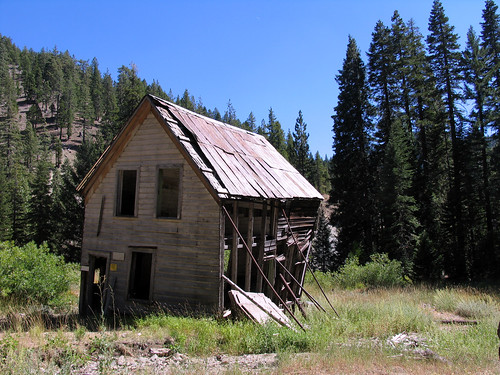 |
| Poker Flat |
The surviving records reveal Richard Quinn as a familiar figure in the community.
In the 1860s he earned a living as a delivery man, carrying meat and general supplies to the nearby mining camps of Howland Flat and St. Louis. Later records list him as the proprietor of a general store in Poker Flat itself. Far from being a transient prospector, he appears to have become an established member of the local economy, adapting as opportunities arose.
Newspaper references and business directories place him in the settlement for decades, supplying miners and residents in an isolated mountain region where every sack of flour and side of beef had to be hauled along difficult mountain roads.
The Waterford Tunnel
The most intriguing discovery concerns a mining claim known as the Waterford Tunnel Mining Company, sometimes referred to as the Quinn Mine.
Records show Richard Quinn holding an interest in the enterprise from at least 1867. In November 1871 he and several associates formally claimed the Waterford Tunnel property near Poker Flat. Additional records from 1872 concern water rights associated with the tunnel, essential for hydraulic and placer mining operations.
The name immediately caught my attention.
Was it simply coincidence that an Irish miner named Richard Quinn, who may have originated in County Waterford, was involved in a claim called the Waterford Tunnel?
Perhaps. Yet the possibility that he named the claim after his home county is difficult to ignore. Miners frequently gave claims names that reflected their origins, aspirations, or identities, and "Waterford Tunnel" feels remarkably specific.
Richard remained connected with the venture for many years before selling interests in the property in the 1870s. Newspaper reports from the 1880s still mention the Quinn claims and improving mining prospects around Poker Flat, suggesting that he remained involved in local mining affairs long after the initial Gold Rush years had passed.
Becoming an American
Another important piece of evidence is Richard Quinn's naturalisation.
Records show that he became a United States citizen in 1867—the very same year that Mary Ann married in Waterford and described her father as a gold digger.
The timing is striking. While his daughter was beginning married life in Ireland, Richard was formally committing himself to life in California.
Yet the marriage record also suggests that the connection between father and daughter had not been completely severed. Someone in Waterford knew both that Richard Quinn was still alive and that his occupation was gold mining. That implies continuing contact, whether through letters, relatives, or money sent home from America.
The End of the Story
Richard Quinn appears repeatedly in the records of Poker Flat through the 1870s and 1880s. Newspaper notices mention his business dealings, mining interests, and local activities, showing that he remained a familiar figure in the community long after the first excitement of the Gold Rush had passed.
By the time he died in 1891, however, the world that had drawn him to California was fading into history. The bustling mining camps of his youth had declined, and many of the men who had rushed west in search of fortune were growing old. His obituary records that he died in the Sierra County Hospital at Downieville, the county seat some miles from Poker Flat. The county hospital served not only as a medical facility but also as an infirmary for elderly, impoverished, or chronically ill residents.
We can only speculate about Richard's final circumstances, but his presence there suggests that age, illness, or declining means had overtaken him. Like many miners of his generation, decades of hard physical labour in the mountains may have left their mark. If he had once dreamed of striking it rich, his life appears instead to have followed the path of countless Gold Rush pioneers—years of hard work, modest success, and an old age spent far from the place where his story began.
Yet he was not entirely forgotten. His obituary notes that he was buried from the Catholic church, evidence that he remained part of the Irish community that had taken root in California's mining districts. More than forty years after he may have left Ireland, he was laid to rest among people who shared his faith, and perhaps his homeland.
If this Richard Quinn was indeed the man named on Mary Ann Quinn's marriage record, his life bridged two extraordinary worlds. Born in Ireland before the Great Famine, he may have left Waterford amid the upheavals of the mid-nineteenth century and travelled to the far side of the world in search of opportunity. There he spent decades as a miner, merchant, and businessman in the rugged camps of the northern Sierra, witnessing California's transformation from frontier goldfields into a settled American state.
Coincidence—or Connection?
No single piece of evidence proves beyond doubt that the Richard Quinn of Poker Flat was the same Richard Quinn recorded in Waterford in 1867. Yet the accumulation of clues is difficult to dismiss.
We have a Waterford marriage record describing Richard Quinn as a gold digger. We find an Irish-born Richard Quinn actively mining in California at precisely the same period. We find a married man living without his family in the goldfields, a mining claim called the Waterford Tunnel, and records placing him in Poker Flat for more than a quarter of a century until his death.
Perhaps future discoveries—naturalisation papers, probate records, family correspondence, or parish records—will finally close the gap between possibility and proof. Until then, I find it hard to believe that all of these details are mere coincidence.
For now, I suspect that the mysterious "gold digger" recorded in Waterford in 1867 was not a local labourer at all, but an Irish emigrant who left famine-era Ireland for the California goldfields and spent the rest of his life among the mines and mountain camps of Poker Flat. If so, a single word on a marriage certificate has preserved the memory of a remarkable journey from Waterford to the American West.
